When Germany invaded Russia, many civilians volunteered to build anti-tank barriers and other defensive structures (pictured right are Russian women building anti-tank structures). Others, however, saw German invasion as liberation because they opposed Stalin and the Soviet regime. Some anti-Soviet Russians joined the Russian Liberation Army (ROA), which fought alongside the Nazis. Many of the men in the ROA were actually from German POW camps. Nevertheless, civilians who lived in areas of the USSR that were claimed by Germany were left to fend for themselves. 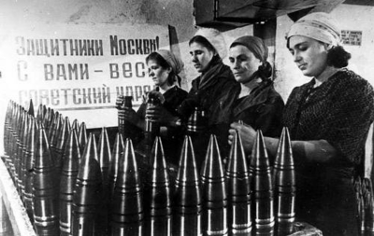 | 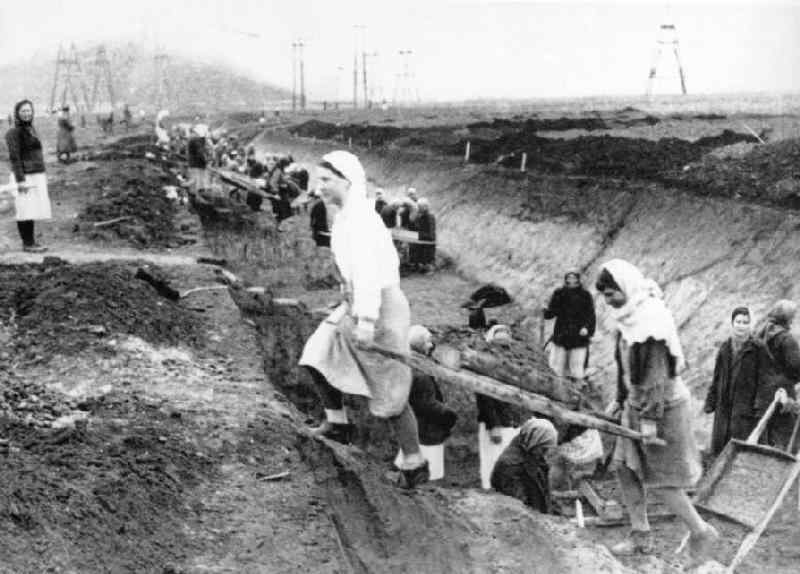 During the German offensive, the Soviet government attempted to destroy farms before the Nazis could gain control of them. Despite this, some farms were captured while in good shape. In the Ukraine, there was enough time to evacuate not only skilled workers and their families but also factory equipment. By 1943 Soviet war production had risen almost to pre-War levels. Civilians in Leningrad, which was cut off from the USSR by Germany, were not as lucky. Thousands of these civilians died of starvation in the winter of 1941-1942 before being evacuated in the spring. When evacuations did take place throughout the USSR, orphanages were given some priority, and about 24% of these evacuated orphans were Jews. |
