Air Raid Precaution Officials and the Metropolitan Fire Brigade issued a series of air raid precaution instructions to prepare Australians for Japanese air raids. These instructions were given to daily and weekly newspapers for publication. 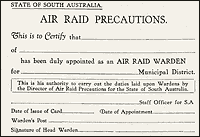 During the early days of WWII, most Australians continued with their daily lives. Prices and unemployment rose, but fear was not widespread until 1941. Many factories turned to war productions, and many civilians began volunteer work. By early 1942, many Australians feared a Japanese invasion. Because of this, blackout restrictions were enforced, air raid instructions issued, and barbed wire strung along many east coast beaches. Like other nations, many women entered the workforce to increase war production. By late 1942, thousands of women had entered the Women's Auxiliary Australian Air Force (WAAAF, pictured below), the Australian Women's Army Service (AWAS), and the Women's Royal Australian Naval Service (WRANS). Other civilians joined organizations like the Red Cross, and still others helped build and patrol coast defences and spot aircraft and ships. Kids collected newspapers, bottles, tires, and other materials that could be recycled for the war effort. In April 1942, the government launched"Austerity" war loans to help fund the war effort. Rationing was introduced in June 1942, and ration books were issued for clothes and food. 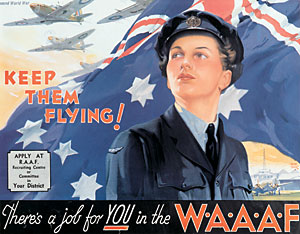 | About 140,000 New Zealand men and women served during the war. Fortunately for New Zealanders at home, they were far away from the actual conflict. New Zealand was spared the death and destruction that came to Britain, the Pacific, and (albeit briefly) Australia. In June 1940, the draft was introduced. Men who worked in industries related to war production were exempt as well as men who worked in "essential industries". These industries included power supply, shipping, mines, munitions factories, and timber mills, but other industries, such as tobacco processing and soapworks, were added or subtracted throughout the war. By 1944, 180,000 NZ men worked in essential industries. Often, attitudes toward exempted men were harsh and judgmental. To fill the job vacancies left by soldiers, "manpower" regulations were introduced. Manpower regulations directed workers where they were most needed. Registering was compulsory at first only for men ages 18-40 and unmarried women ages 20-21. Eventually, men up to age 70 were required to register as well as married women. Making women perform paid work was against tradition, going against the belief that women should perform domestic work. But by the war's end, 38,000 had been sent to work wherethe government directed them. http://www.nzhistory.net.nz/war/second-world-war-at-home/war-work http://www.nzhistory.net.nz/war/second-world-war-at-home http://www.ww2australia.gov.au/allin/ |
